
How the standardisation of spare parts optimises the repairability of industrial products
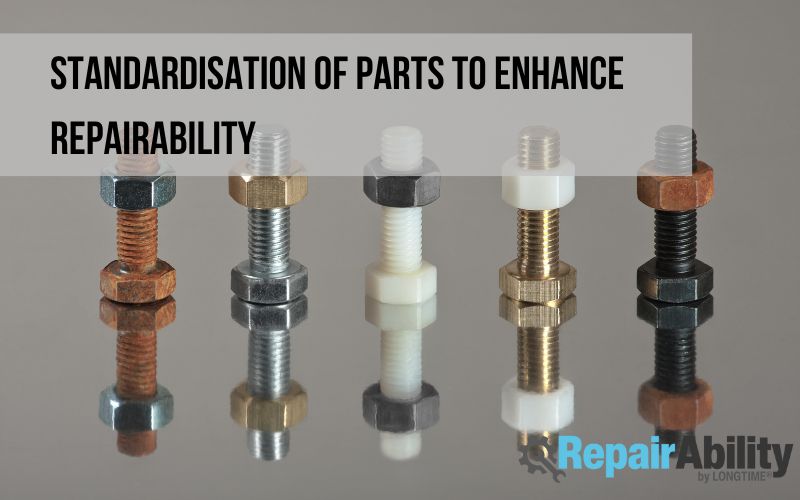
In an industrial environment shaped by heightened requirements for durability, repairability and control of non-quality costs, the standardisation of spare parts is emerging as a strategic lever. According to ADEME, global electronic waste reached 57.4 million tonnes in 2021, of which only 17.4% was recycled¹. This situation is prompting manufacturers to rethink product design in order to improve repairability and encourage a circular-economy approach. By reducing component diversity and simplifying replacement, standardisation contributes effectively to these objectives, while optimising maintenance, procurement and logistics.
Standardising to repair better: a response to regulatory and economic challenges
In the face of growing pressure from environmental policies and the need for a more circular industry, French and European regulations are introducing new obligations relating to repairability, ease of disassembly and product durability. In this context, component standardisation is emerging as a strategic lever, both technical and regulatory.
In France, the AGEC law has required, since 2021, a visible repairability index on several categories of equipment. This scheme will soon be strengthened by a durability index, taking into account robustness, upgradability and software availability.
At European level, two structuring texts stand out:
the ESPR Regulation (Ecodesign for Sustainable Products Regulation), which will introduce a comprehensive approach to improving sustainable product design, by requiring technical documentation, disassembly criteria, and enhanced accessibility of spare parts;
the proposal for a Right to Repair Directive, which aims to guarantee an effective right to repair for consumers and professionals, by facilitating access to parts, documentation and the necessary tools.
To support these developments, several reference standards are becoming essential:
NF EN 45554, for assessing a product’s capacity to be repaired, reused or upgraded,
the ISO 20887 standard, for analysing repairability from the design stage,
and the future EN 45559, for environmental communication relating to energy-related products.
Standardising interfaces, fasteners and modules therefore becomes a powerful tool for meeting these obligations: it facilitates maintenance, reduces after-sales service costs, speeds up compliance, and enhances product value within the logic of an operational circular economy.
The technological diversity of components: a barrier to repair
The growing diversity of technologies and spare-part types (mechanical, electronic, optical or thermal) makes repair operations more complex. This technical heterogeneity complicates stock management, tool selection and technician training.
Nature of components: mechanical, electronic, optical, thermal…
Modern equipment incorporates a wide range of components: mechanical parts (gears, bearings), electronic parts (printed circuit boards, microprocessors), optical parts (lenses, sensors) and thermal parts (heatsinks, heat spreaders). This technical diversity makes both stock management and technician training more complex. According to an INSEE study, component diversity can account for up to 70% of logistics costs in certain industrial sectors⁵.
Assembly methods: soldering, bonding, clipping, screwing
The assembly methods directly affect the ease of access to parts. Soldering ensures mechanical robustness, but severely limits disassembly (e.g. soldered BGA components), whereas clipped or screwed fastenings, by contrast, make maintenance and replacement operations easier. For example, in home appliances, the growing use of bonding often makes it impossible to replace a part without damaging the assembly as a whole, which is a major barrier to repairability.
Case study: clipped battery vs soldered battery — two opposing approaches
In mobile devices, a clipped battery can be replaced in a few minutes with minimal tooling, thereby extending the service life of the device. Conversely, a soldered battery often requires full disassembly, or even partial destruction of the casing, greatly reducing the chances of repair and encouraging full product replacement. According to iFixit, the average repairability score of a smartphone with a soldered battery is 30% lower than that of a model fitted with a clipped battery⁶.
Standardisation: a practical lever to make repairs easier
Standardisation is a key lever for simplifying repair. By harmonising dimensions, formats and compatibilities, it makes it easier to swap parts, reduces costs and enables the use of universal tooling.
Defining a standardised component: dimensions, formats, compatibility
A component is described as standardised when it complies with a set of recognised, shared technical specifications, making it easier to interchange between different devices or manufacturers. These specifications cover several dimensions:
- Physical dimensions: dimensional tolerances (e.g. ISO 286 for fits), fixing centres, diameter, length or cross-section. This allows mechanical integration without modification.
- Interface formats: electrical connectors (e.g. IEC 60320 for appliance couplers and power supply cords), communication ports (e.g. USB-C as defined by USB-IF), or standardised software interfaces (e.g. the Modbus protocol for industrial motors).
- Reference standards: international standards such as the ISO series (e.g. ISO 10664 for Torx screws), DIN, IEC or EN provide functional, geometric and sometimes regulatory compatibility.
This technical homogeneity reduces the variety of parts that need to be stocked, makes sourcing from different suppliers easier, and speeds up repairs by limiting compatibility constraints. It is also a lever for modular design, as it enables product architectures to be conceived around interchangeable functional blocks, supporting upgradability and repairability.
Benefits: interoperability, lower costs, universal tooling
Component standardisation brings decisive benefits for industrial product design, maintenance and logistics:
- Interoperability: a standardised component can operate in different technical environments without requiring adaptation, thanks to common physical, electrical or software interfaces. This compatibility makes repairs, upgrades and integration into multi-manufacturer systems easier.
- Reduced logistics and intervention costs: by limiting parts diversity, standardisation enables pooled stock, reduces downtime and simplifies supply chains.
- Universal tooling: using standards such as Torx fasteners or IEC connectors reduces the need for specialist tools, limits assembly errors, and supports repairs on site or in multi-brand workshops.
Practical examples of standardisation serving repairability
In home appliances, the standardisation of refrigerator compressors is a long-established practice that greatly facilitates maintenance operations. Thanks to harmonised formats, mountings and connections, it is possible to replace a faulty compressor with an equivalent model, regardless of brand, without any structural modification. This interchangeability reduces the rate of full appliance replacement and significantly lowers intervention costs.
Another emblematic example is small universal electric motors, used in many portable devices (vacuum cleaners, drills, fans). These motors, often designed to dimensional and electrical standards, can be replaced or reused easily across different applications, extending product lifetimes and simplifying spare-parts management in the workshop.
In professional lighting, standardised LED modules (e.g. Zhaga) ensure compatibility between manufacturers and enable quick maintenance, without modifying the power supply or mounting. This type of initiative shows that standardisation is not merely a technical lever: it is a key resilience factor for manufacturers in the face of environmental and economic challenges.
The cost of a lack of standardisation
A lack of standardisation generates high costs: proprietary formats, specialist tools and limited documentation make repair more difficult, extend lead times and hinder competition.
Proprietary formats: a barrier to repair and competition
The use of proprietary formats fuels a recurring debate between repairability imperatives and product innovation. On the one hand, these formats allow some manufacturers to design optimised, compact or high-performance components that are difficult to achieve using existing standards. Without this freedom, technologies such as the compact brushless motor or ultra-thin designs might never have emerged.
However, when these technical specificities are not accompanied by transparent access to tools or documentation, they become a barrier to independent repair and circularity. For example, Pentalobe screws, popularised in some smartphones, initially restricted access to internal components. But the tooling industry adapted quickly, making these screws accessible to any repairer with the right tools. This shows that a balance between innovation and technical openness is not only possible, but desirable.
What must be avoided is an intentional lock-in strategy (software locks, lack of documentation, irreversibly soldered components) that prevents any repair or reuse outside the manufacturer’s network. In that case, the proprietary approach no longer serves innovation, but creates artificial customer dependency, which runs counter to durability objectives.
Current European regulation (the Ecodesign Directive, the repairability index, the Right to Repair project) is also tending to recognise this need for partial openness, by allowing innovation while requiring reasonable access to parts, tools and information for authorised professionals.
Technical lock-ins: when lack of openness holds back repairability
In the field, repair professionals regularly face obstacles linked to inaccessibility of technical documentation or the use of specific, non-standardised tools. According to a survey by the Federation of Electronics Repairers, 67% of interventions are delayed because of these limitations, with direct impacts on productivity, costs and customer satisfaction.
Certain components or assembly methods worsen this situation: Pentalobe screws, proprietary connectors or irreversibly soldered elements (e.g. batteries or electronic modules) make disassembly operations complex, or even destructive. A sector analysis shows that these obstacles can increase repair costs by 30 to 40% and drive premature replacement of products, contradicting the objectives of durability and the circular economy.
Although the tooling market has partially adapted to these challenges (for example, Pentalobe screwdrivers are now readily available), the lack of open standards and restricted access to documentation (drawings, disassembly procedures, error codes) still limit the autonomy of independent repairers.
For manufacturers, this highlights the need to build a strategy of reasonable accessibility into the design stage: providing the minimum tools, information and interfaces required for an effective repair, without giving up on product innovation.
How designers can promote repairability through standardisation
Designers play a key role by embedding standardisation from the design phase. Choosing removable fastenings, shared formats and reversible materials are all levers for improving repairability.
Standardised design: how component choices simplify maintenance
The standardisation choices for components made at the design stage have a direct impact on product repairability and maintenance. By opting for standardised formats, removable fastenings and reversible assemblies, repair operations are simplified and lead times are reduced. Conversely, using proprietary parts or irreversible assemblies increases repair complexity and generates additional costs. An internal study conducted in the automotive industry showed that component standardisation enabled a 20% reduction in average maintenance times across several production lines, demonstrating its effectiveness in operational performance terms.
Embedding standardisation from the product design stage
The design phase is the main leverage point for ensuring a product’s future repairability. It is at this stage that ease of disassembly, modularity and component compatibility are determined. By incorporating standardised elements upstream, designers can greatly simplify maintenance, replacement or upgrade interventions.
The methodological frameworks of Design for Maintenance (DfM) or Design for Repairability recommend:
using reversible and visible fastenings (screwing, clipping),
creating modular functional sub-assemblies,
choosing standardised formats and interfaces (USB-C, DIN, ISO, etc.),
and reducing the number of disassembly steps, using methodologies such as the eDIM (Ease of Disassembly Index), referenced in the EN 45554 standard.
This approach not only reduces intervention times, but also minimises the risk of damage during disassembly and facilitates the use of reused or refurbished parts. It also fits perfectly into a product-as-a-service strategy, where repairability becomes a condition for profitability.
Finally, integrating normative repairability criteria (EN 45554, ISO 20887) into product specifications makes it possible to anticipate regulatory requirements while structuring the dialogue between designers, maintenance teams and independent repairers.
Drawing on field expertise: an asset for designing genuinely repairable products
Direct involvement of repairers and maintenance technicians in the early stages of product development helps to reveal friction points that are often invisible from the design office. These professionals have detailed knowledge of practical obstacles to repair: physical accessibility of components, assembly logic, interface reliability, parts availability, and the readability of technical diagrams.
Setting up a structured field-feedback loop — via after-sales feedback, co-design groups or post-launch audits — makes it possible to:
identify technical bottlenecks affecting real-world repairability;
improve design choices (fastenings, wiring, modules);
prioritise critical components in functional value analyses;
and align the product with real intervention conditions (required skill level, tools available, repair environment).
According to a study conducted by the Institute for Technological Research (IRT), this collaborative approach could reduce after-sales costs by 15%, while improving customer satisfaction and reducing product requalification cycles.
At a time when the NF EN 45554 standard recommends a use-centred product approach, integrating field feedback from the design stage becomes an essential condition for developing products that are repairable, reliable and durable.
Conclusion: standardise to repair, design to last
Component standardisation is not merely a technical or logistical lever — it is a strategy for responsible innovation that addresses regulatory expectations, economic constraints and growing circularity requirements. By harmonising formats, interfaces and assembly methods, manufacturers can:
reduce their maintenance and after-sales service costs,
extend the service life of their products,
simplify the integration of spare or refurbished parts,
and anticipate obligations arising from the AGEC law, the durability index or the ESPR Regulation.
For design offices and manufacturers, embedding repairability from the design stage is becoming a strategic necessity. This means drawing on standard reference frameworks (in particular NF EN 45554), working with field stakeholders (repairers, maintenance professionals), and making technical choices compatible with the circular economy.
Are you designing an industrial product or rethinking a product architecture? Contact our team to discuss repairability assessment under EN 45554 and the standardisation levers applicable to your product ranges.
Sources
¹ Global E-waste Monitor 2023, UNEP
² Directive 2009/125/EC - European Commission, 2021
³ McKinsey & Company, “The hidden value of component standardisation”, 2022
⁴ Internal study by a European automotive manufacturer, 2023
⁵ INSEE, Industrial logistics and component-related costs, 2021
⁶ iFixit Repairability Scores, 2022
⁷ Household appliance sector study, 2020
⁸ Federation of Electronics Repairers, survey 2023
⁹ Sector analysis of repair costs, 2022
¹⁰ Institute for Technological Research, report 2022